

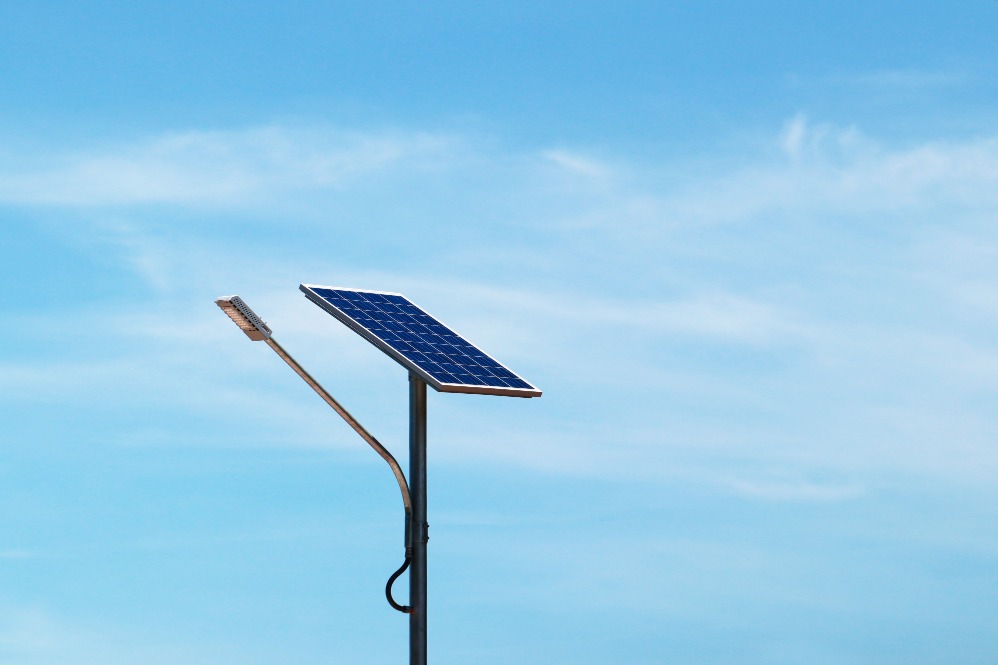
Outdoor lighting is essential for roads, pathways, housing societies, institutional campuses, industrial premises, farm boundaries, and public areas. However, extending conventional electrical wiring to every outdoor location can be costly and difficult. Solar Street Light Installation in Haryana provides an alternative by generating and storing energy at the lighting point itself.
A well-designed solar street light can improve nighttime visibility without depending entirely on conventional power infrastructure. Its effectiveness, however, depends on the correct selection of light output, battery capacity, installation height, and placement.
Where Solar Street Lights Work Well in Haryana
Solar street lights can be installed in locations where reliable outdoor illumination is needed but underground cabling or grid extension may not be practical.
Common applications include:
- Internal roads in residential societies and townships
- Factory entrances, parking areas, and warehouse boundaries
- Schools, hospitals, parks, and institutional campuses
- Farmhouses, rural roads, pathways, and agricultural premises
- Construction sites and developing layouts
The lighting requirement should be assessed according to road width, pedestrian activity, surrounding structures, security needs, and expected operating hours.
Select the Right Lighting Configuration
Solar street lights are available in integrated and semi-integrated configurations. An integrated unit combines the panel, battery, controller, and LED light into a compact assembly. A semi-integrated system uses separately positioned components, providing greater flexibility in panel orientation and maintenance.
Neither option is automatically suitable for every project. Integrated systems can simplify installation, while separate components may be useful when the light location receives partial shade or requires a larger battery.
Important Specifications to Evaluate
Wattage alone does not determine lighting performance. Buyers should also examine lumens, beam distribution, battery type, panel capacity, charging time, backup duration, controller quality, and ingress protection.
Before approving a product, verify:
- Expected illumination level and coverage area
- Battery backup during cloudy or foggy conditions
- Pole height, spacing, strength, and foundation design
- Automatic dusk-to-dawn operation
- Product and battery warranty terms
Haryana’s dust, summer heat, monsoon rainfall, and winter fog should be considered during equipment selection.
Avoid Uneven Placement
Poorly spaced lights can create alternating bright and dark areas. This reduces visibility even when high-output fixtures are used. Pole spacing should be planned through a lighting assessment rather than estimated casually.
Panels must also remain free from shadows created by trees, buildings, poles, hoardings, and nearby structures. Future tree growth should be considered during site planning.
Maintain Performance After Installation
Solar street lights require comparatively limited maintenance, but they are not completely maintenance-free. Panels need periodic cleaning, particularly in dusty areas. Batteries, fixtures, wiring connections, poles, and foundations should also be inspected.
A maintenance schedule helps identify declining battery performance or damaged components before complete lighting failure occurs.
For a location-specific lighting plan covering pole placement, illumination needs, and equipment selection in Haryana, arrange a solar street light assessment with SUNGRID Solar.